
For carbon and restoration projects
Drop the sites that fail before the field trip
Forest history year by year, land cover, protected areas and community land for every site on your list, ranked side by side. Your analyst checks the ones that survive.
TERRA is in private beta, and places are limited. A member's invitation code lets you in at once; without one, ask for a place.
Pages from the TERRA report
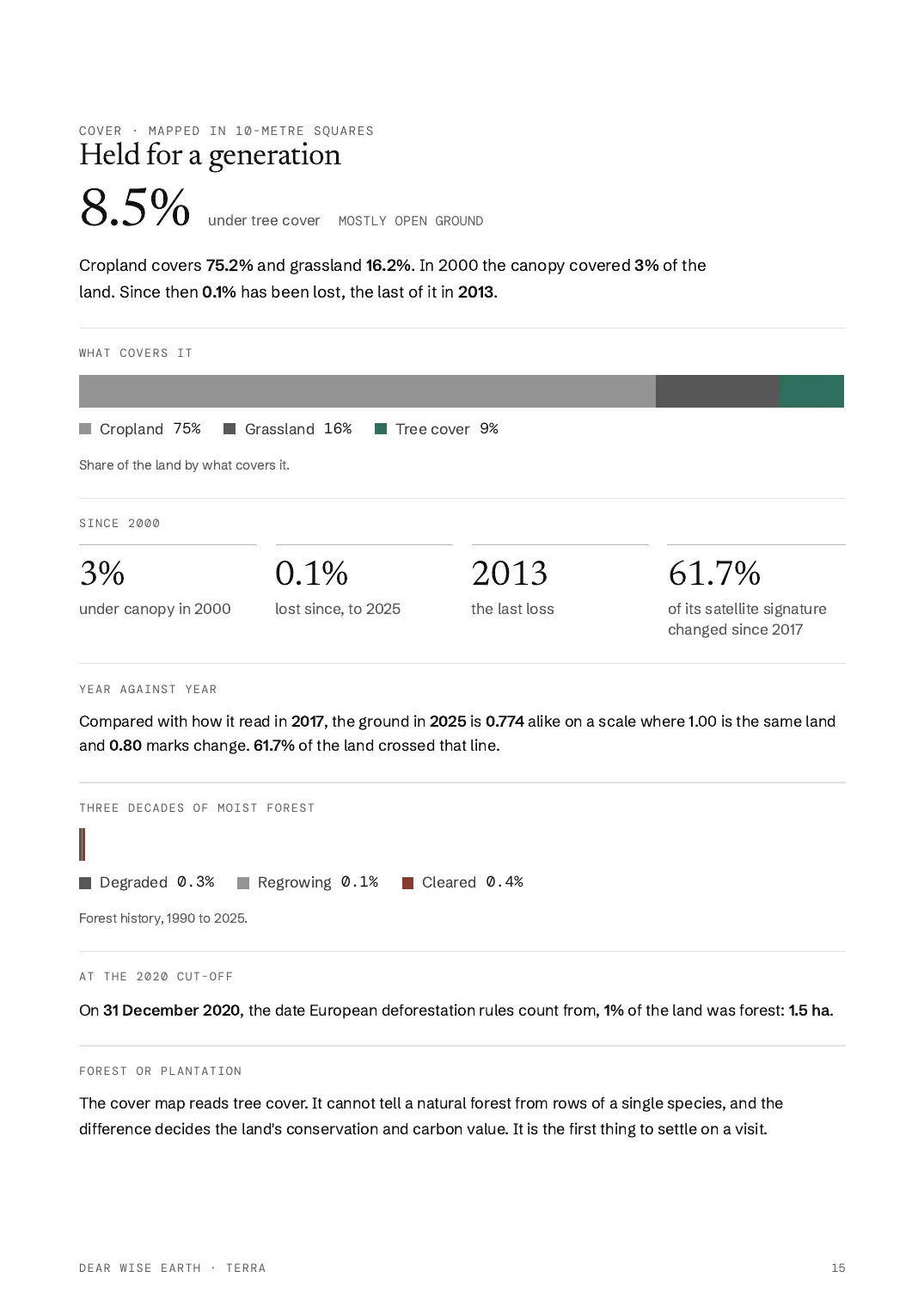
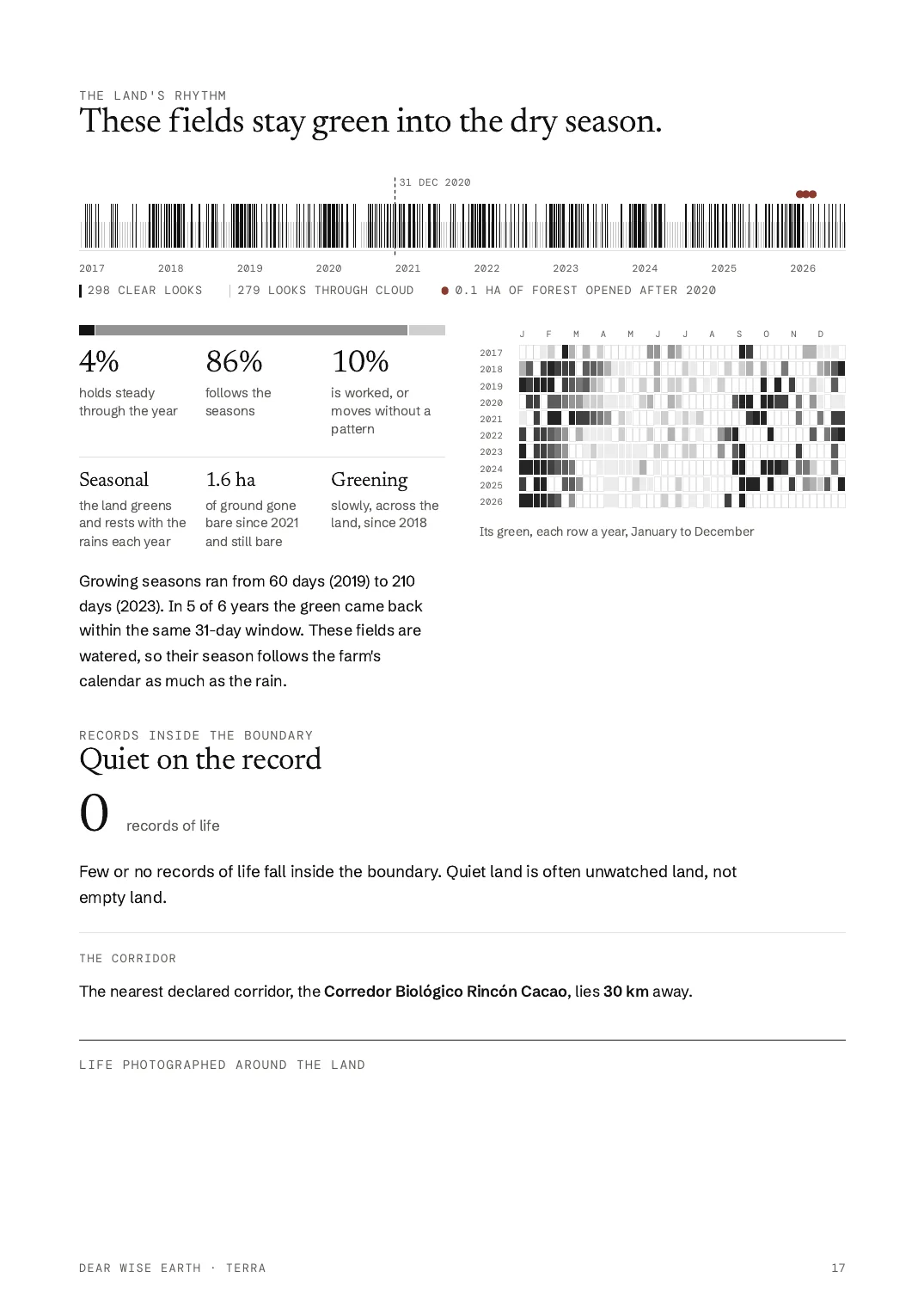
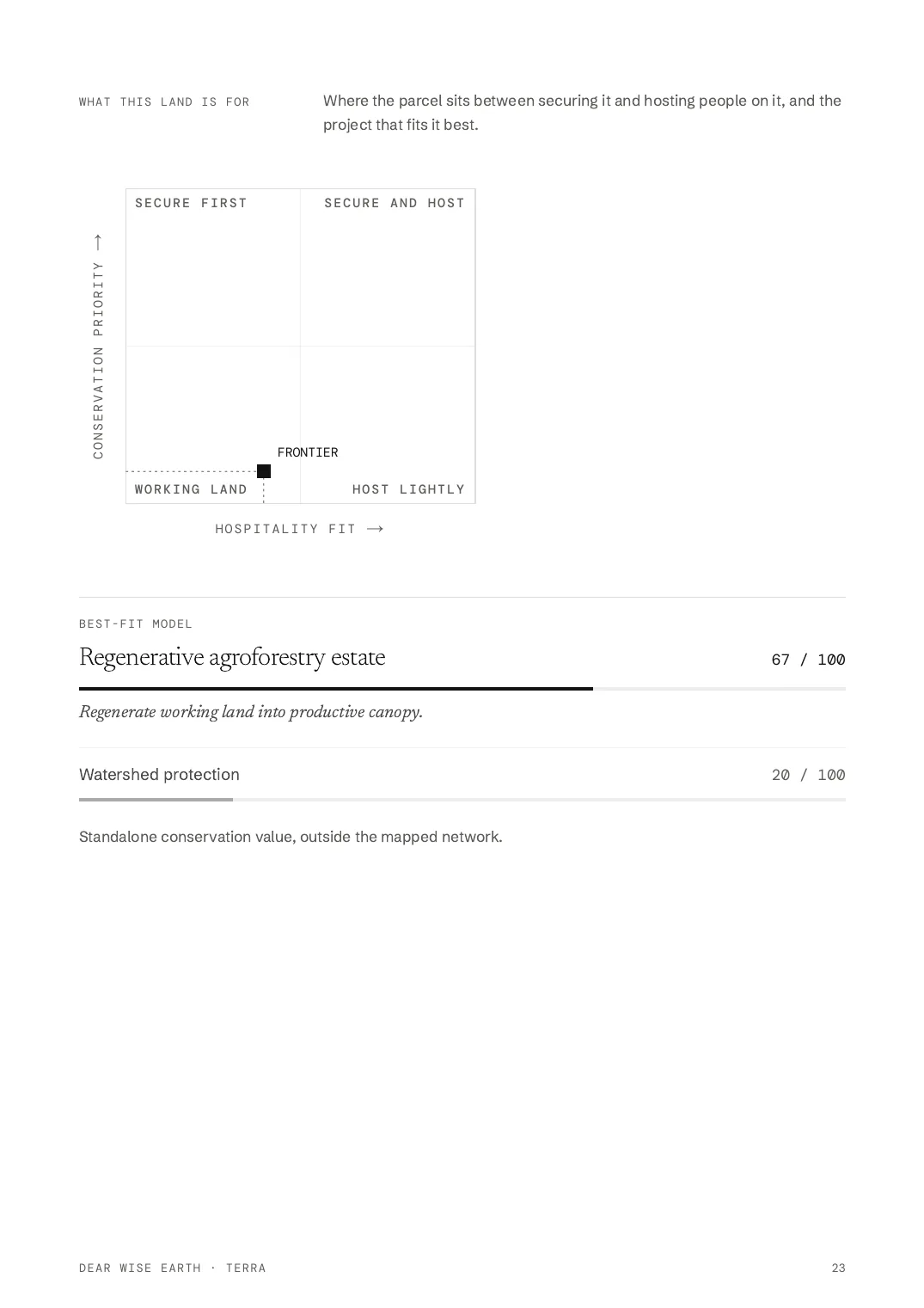
What goes wrong
01
Sites fail eligibility after the money is spent
Land cleared in the ten years before the start, plantations counted as forest, standing forest where planting was planned. Each is found after the field trip, sometimes after the credits.
TERRA answers itTree-cover loss year by year since 2001 for every site, before anyone travels.
02
Every feasibility study is a five-figure bet
FAO puts a feasibility study at EUR 15,000 to 25,000 per project, before the project document and the validation.
TERRA answers itA first pass on the whole list for less than one field trip.
03
Overlaps with community land found late
Once a project touches an indigenous or community territory, prior consultation can take years.
TERRA answers itProtected areas in every reading and, in Brazil and Colombia, indigenous and community land.
04
Buyers and raters dig into land history
Since the 2023 reports of over-crediting, buyers and rating firms check the history of every hectare.
TERRA helpsA dated history with its source for each site, ready for their questions.
What TERRA does not do
TERRA does not validate, set a baseline or settle tenure. It screens before the validator, and the method is shown to your validator under a confidentiality agreement.
How TERRA reads the land for you
Room to restore and conservation priority
Read your candidate sites for where restoration has the most to gain and which land to secure first, before any field budget is spent. TERRA does not estimate carbon income or issue credits.
Ask three worked sites which to restore →- 01Room to restore: strong water and climate on land whose ecology is still low, where restoration has the most to gain and the means to hold
- 02Connection: protected land on or near the site and, in Costa Rica, the declared biological corridors
- 03Standing value: the forest and canopy already on the land, worth securing
- 04Threat: forest lost since 2000, recent clearing, and a road close to corridor land
- 05The capital tier: Keystone to secure now, Corridor to restore inside the network, Buffer to steward beside it, Frontier valued on its own
- 06Regrowth: how many years cleared ground within 10 km takes to become forest again (tropical moist forest only)
What you will use
Only what your decision needs.
What the land is suited for
Each site's conservation priority, 0 to 100, its capital tier (Keystone, Corridor, Buffer or Frontier) and what to do first.
Forest and its history
Forest lost each year since 2000 on every site. In the moist tropics, the record starts in 1990 and marks where plantation replaced forest.
Protected and community land
Protected land on and around each site, indigenous and community land in Brazil, Colombia and Costa Rica, and Costa Rica's biological corridors.
How fast forest returns
How many years cleared ground within 10 km takes to become forest again when left alone. Tropical moist forest only.
Your portfolio
Every candidate site on one map and in one table, the five pillars side by side, with a link to share.
Private readings
Read a candidate site before the owner knows you are looking. Nobody else can open the reading unless you publish it.
Ask across your lands
Ask which site has the most room to restore or which to conserve first, and see them ranked with the figure behind the order.
Risk across your lands
One CSV row per site: tree cover in 2000 and its loss, protected overlap, conservation priority, capital tier and the sources that stayed silent.
Read again
Read any site again a season later and see what changed since the last reading, for the monitoring file.
Reports
Each site's reading as a dated, signed PDF, ready for an investor or for the first questions a verifier asks.
Data rooms
A private room per site for the investors and credit buyers who must say yes, each reader let in by passphrase.
TERRA Watch
A daily look for fire nearby and, in the tropics, new clearing, with alerts to your phone and a dated record of every look.
Later, when you need itWater through the year · Climate to 2050 · Your own documents · A report for one decision · Volume
What TERRA reads for you
- Forest history since 1990, year by yearMoist tropics
- Land cover since 1986Amazon sites
- Who holds the landBrazil, Colombia
- Biomass todayPer site
- Corridors it would joinCosta Rica
- Ranking across your listTable
Before you start
Does this make a site eligible?
No. It screens before your validator. Every figure names its source and date, and the method is shown to your validator under a confidentiality agreement.
Forest history from the satellite record and, in the Amazon, the yearly land-cover maps. Each reading prints the dates its records cover and marks any record that did not answer.
Your portfolio
Your candidate sites, ranked side by side.
Hold your candidate sites in Your portfolio and read them in one table, pillar by pillar. With Pro, ask which has the most room to restore, or which to conserve first. The answer ranks the sites from their readings and says what the order weighs. Export the table to CSV, and read any site again a season later.
Open three worked sites →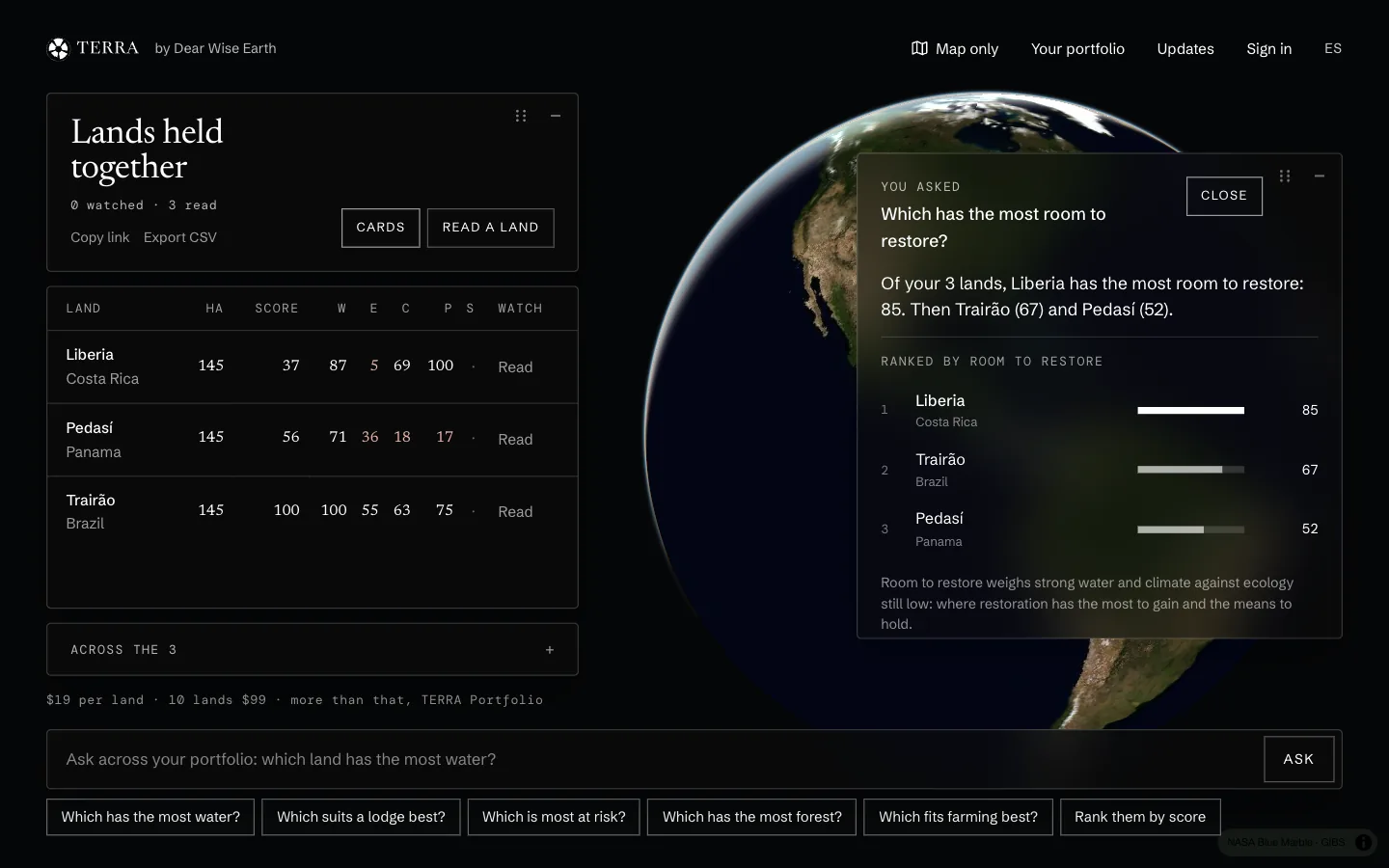
Carbon and restoration
Read your first site in private, then rank the list.
TERRA is in private beta, and places are limited. A member's invitation code lets you in at once; without one, ask for a place.