
For sustainable real estate developers
Know which lot you can build on before paying for studies
Flat ground, the strips the law keeps beside water, protected land, trees that need a felling permit, the road and the power grid. TERRA reads each candidate lot through its sustainable real estate lens and gives it a class, from Buildable to Not a building site, with the reasons beside it.
$39a monthor $390 a year
Paid through Contra, which holds the card and handles the tax. To stop, write to connect@dearwise.earth. Access runs to the end of the paid period.
Pages from the TERRA report
What goes wrong
01
The lot's problem shows up after the deposit
Forest where the buildings would go, a protected area, a river strip, a slope too steep to build on, each found after the deposit or the study. In Mexico, clearing one hectare of tropical forest costs MXN 173,072 in compensation.
TERRA answers itThe sustainable real estate lens on every candidate lot, before a deposit or a study is paid.
02
Impact studies are paid lot by lot
Each study takes weeks and is paid per lot, so two of ten candidates get studied and the rest are a guess.
TERRA answers itTen lots read in a day, each with its class. Your consultant studies the ones that pass.
03
Projects are closed with the work under way
In March 2026, Mexico's environmental agency closed six developments in Cabo Pulmo National Park for building without federal environmental authorisation.
TERRA helpsA lot inside a protected area reads Not a building site before you buy it. The permit stays with the authority.
04
Investors ask for evidence the deck doesn't have
Renderings show what you plan to build. Partners and lenders ask what the land says, and nobody has put that on one page.
TERRA answers itThe full development reading prints for the investment memo. With Pro, a dated, signed report and a private data room for the lot.
What TERRA does not do
TERRA does not replace the impact study, the topographic survey, the title search or the permit. It tells you which lots need them first.
How TERRA reads the land for you
Sustainable real estate
Whether each lot is a building site, and on what conditions, before you pay for a single study.
See a worked land read for building →- 01Ground to build on: how much of the lot is flat enough, and how steep the rest runs
- 02Legal and environmental limits: protected land, the strips the law keeps beside water, trees that need a felling permit, biological corridors
- 03Hazards: what the district screens high for, and ground on the lot that sits low or wet
- 04Access and services: the main road, the power grid, the nearest fire station or emergency post
- 05Climate and water: rain, the dry months, heat and rain by 2050
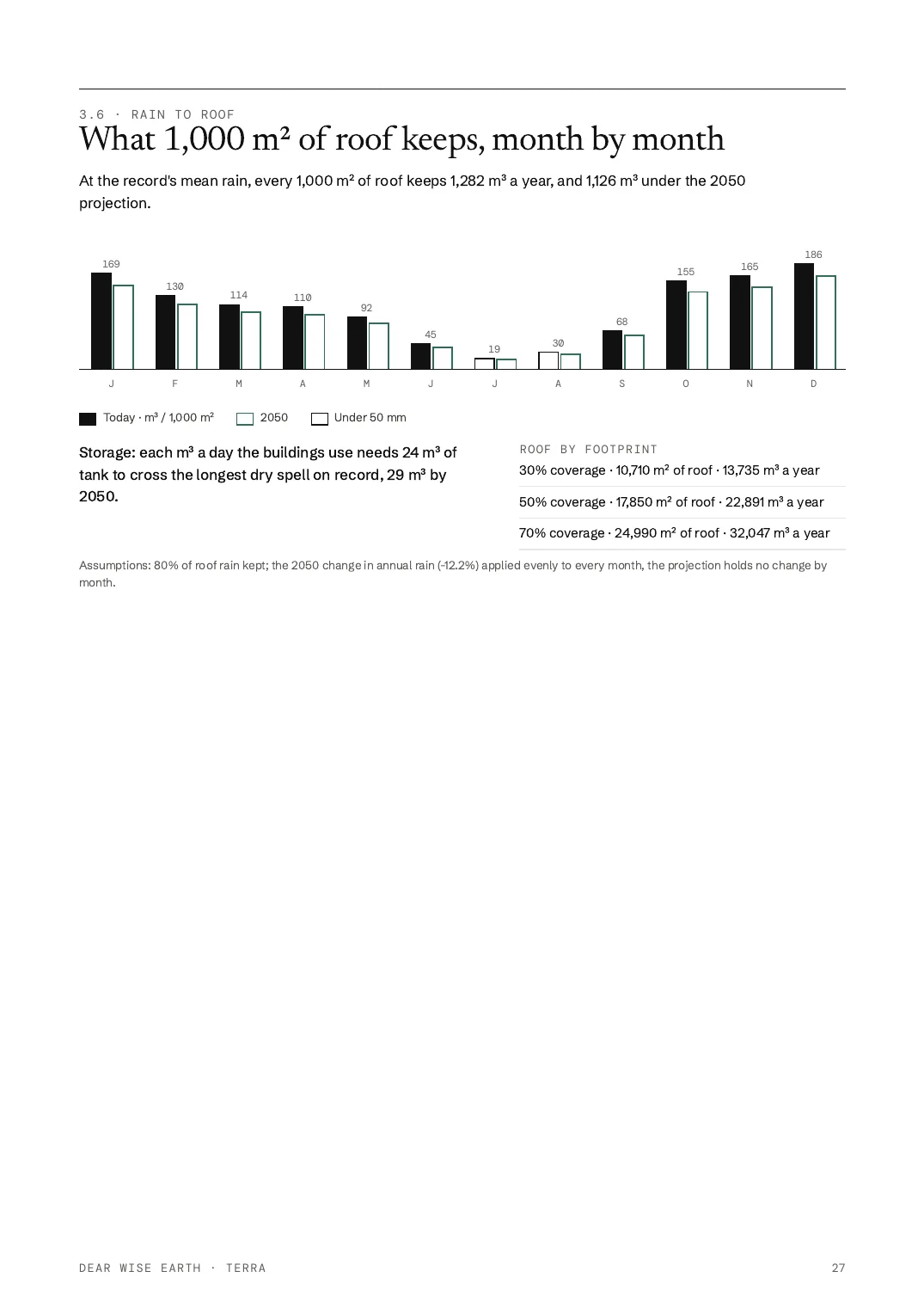
- 06What building well can claim: trees planted back toward what the land would carry, and rain the buildings can run on
- 07A class from Buildable to Not a building site, with hard stops for protected land and, in Costa Rica, indigenous territory and the public shore
What you will use
Only what your decision needs.
Free
Water through the year
Rain through the year and the dry months the residents' water has to last through.
Ground and slope
Slope, height, relief and soil, read before the foundation study.
Forest and its history
Canopy today and every year of loss since 2000, read before anyone applies for a felling or clearing permit.
Protected and community land
Protected areas on or near each lot. A lot inside one, or inside an indigenous territory in Costa Rica, reads Not a building site.
Climate to 2050
Heat, rain and dry spells today and by the late 2040s, over the life of the buildings.
Access and services
The main road, the power grid and the nearest fire station or emergency post, measured from the land.
Hazards on this land
Fire, flood, landslide, storm, drought and quake on this land, and what to check before the engineers design for them.
Where to build
Level ground above the flood line and outside the strips beside water, the best piece for the footprint and its distance to the road.
The sustainable real estate lens
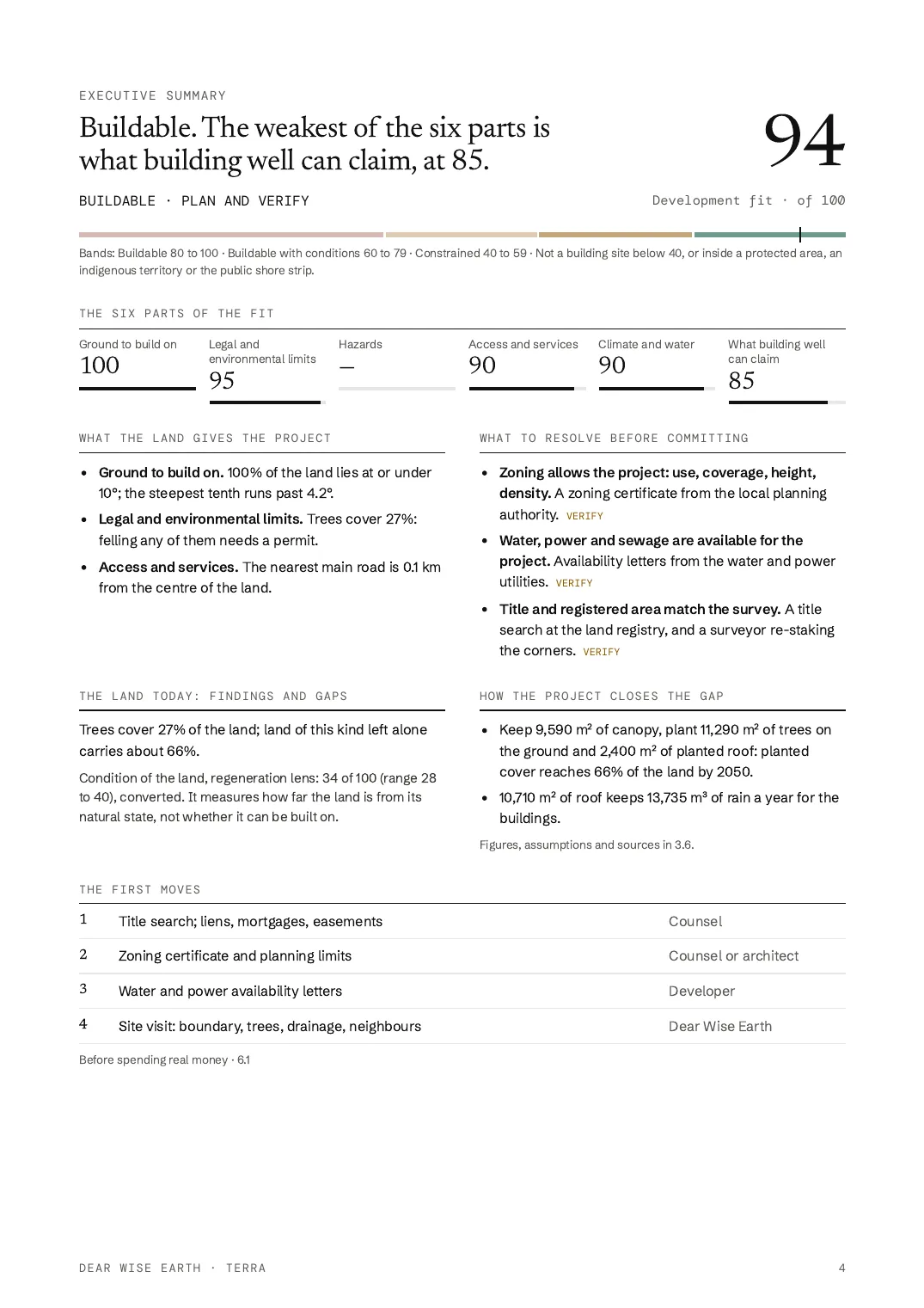
Each lot read for building, its six parts named, then a class from Buildable to Not a building site with the reasons beside it.
Your portfolio
Your candidate lots on the Earth and in one table, the five pillars side by side, with a CSV for your consultant.
With Pro
Private readings
Lots under negotiation stay private. Nobody else can open the reading, and it is published only if you choose.
Ask across your lands
Ask which lot has the least tree cover or the most water, and see the lots ranked with the figure behind each.
Reports
The reading as a dated, signed PDF for investors and lenders.
Data rooms
A private room for the chosen lot, where investors and lenders read the evidence, each let in by passphrase.
Add-ons
A report for one decision
The Site Screen, issued by hand for the lot you choose, before the design starts.
Later, when you need itWhere the water goes · The shape of the land · A film to share · Ask the land · Risk across your lands · Read again · Your own documents · TERRA Watch
What TERRA reads for you
- Flat ground and slopePer lot
- Water strips, protected land and treesPer lot
- Hazards the district screens forBy district
- Road, power grid and emergency servicesPer lot
- Rain, dry months and heat by 2050Per lot
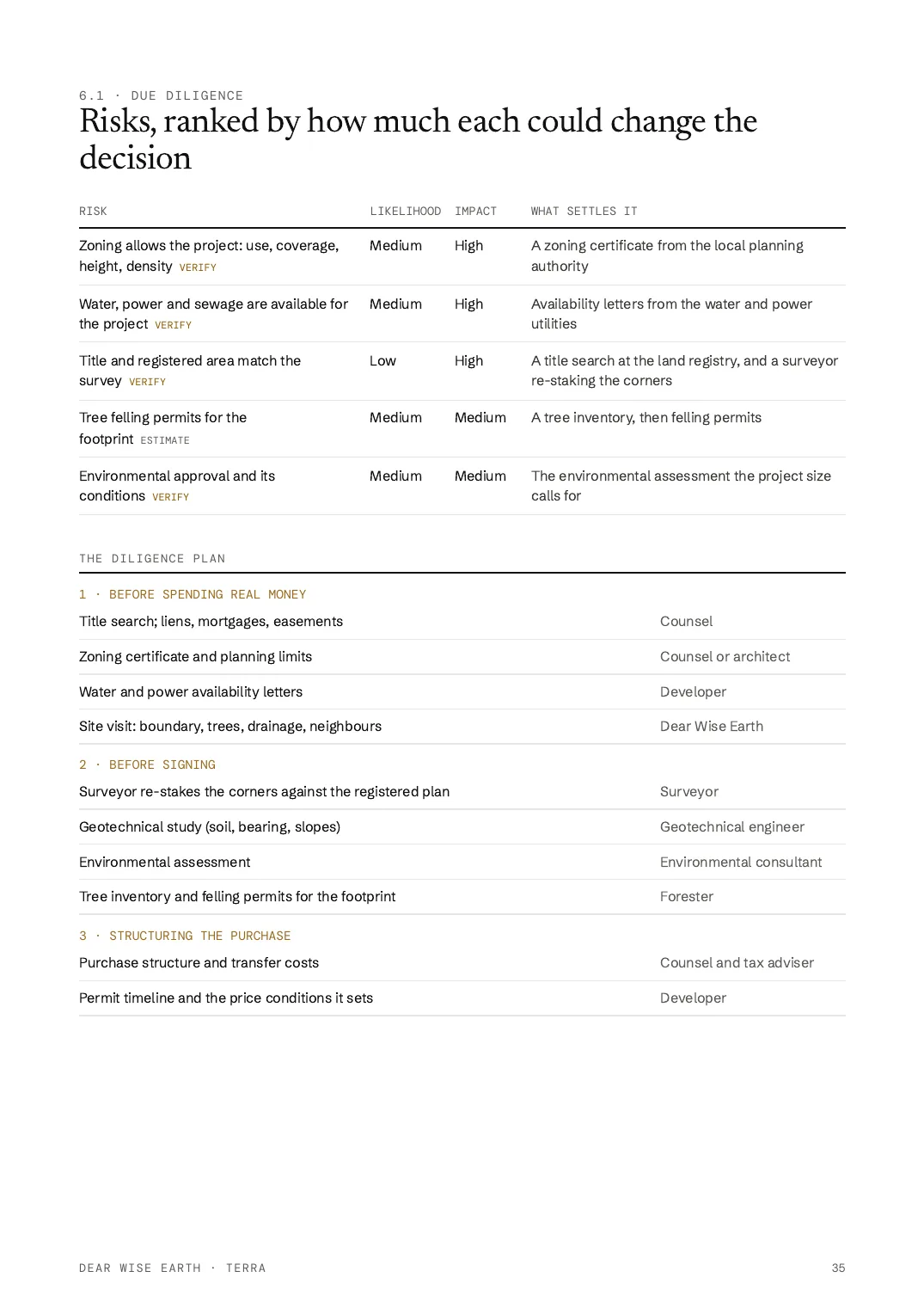
- Risks ranked and the diligence planPrintable
Before you start
Does this replace my environmental consultant?
No. Your consultant still does the impact study and signs it. TERRA tells you which of your lots deserve one, before you pay for ten.
Every figure in the lens is marked by how sure it is: from the owner's papers, a remote estimate, arithmetic on those, or to verify on site. Zoning, utility capacity and title are listed as unknowns, never guessed.
The sustainable real estate lens · free
Every lot read for building, with its class and the reasons.
Open any lot up to 5 hectares and choose Sustainable real estate under Read for. The lens gives the land a class from Buildable to Not a building site and, where it can be built on, a fit out of 100. It draws the six parts as bars and lists the risks that could change the deal, each with what settles it. The full development reading prints with the diligence plan, the documents to ask the seller for and what TERRA cannot read.
Open the Braga lot in this lens →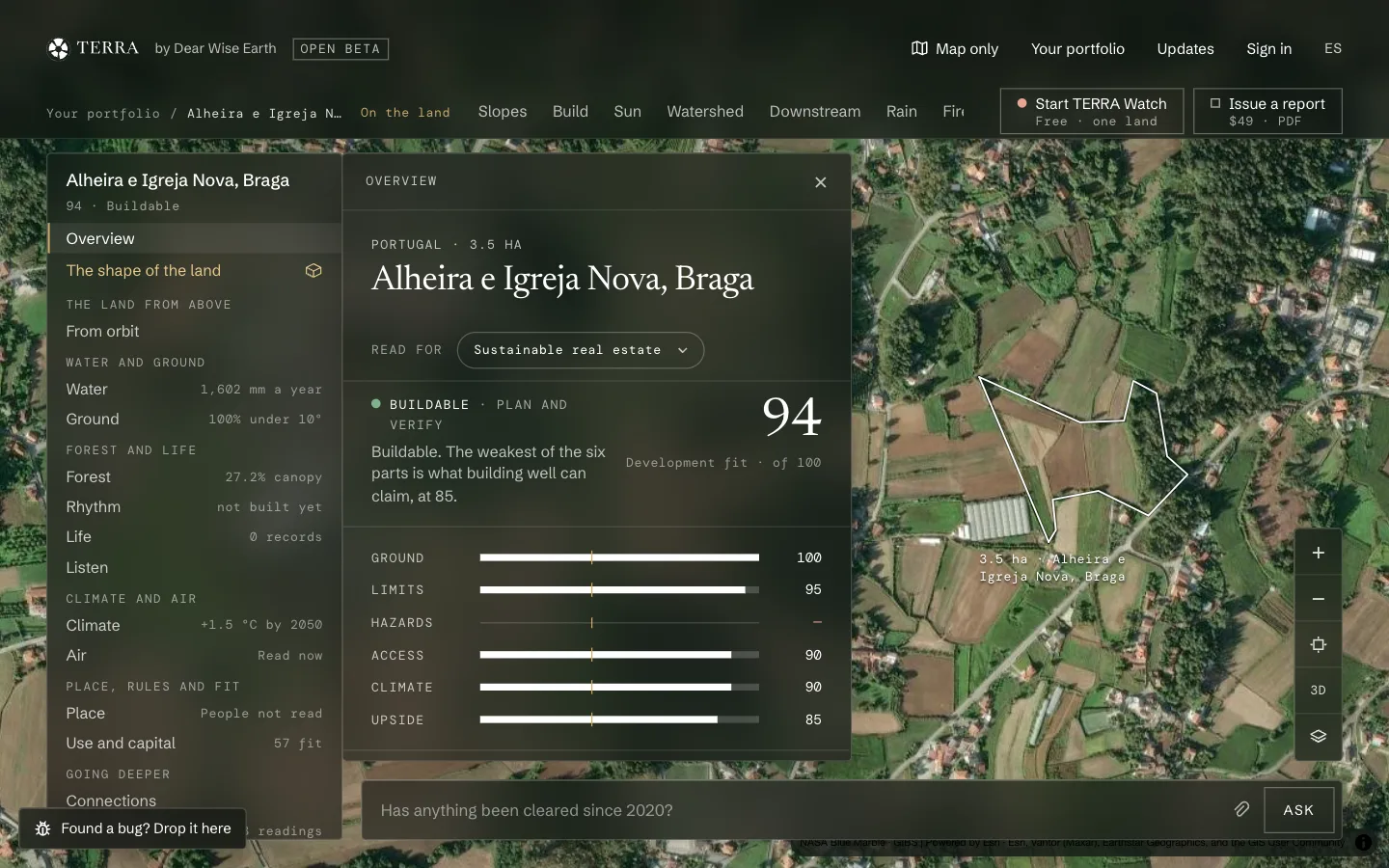
Add to Pro, for this case
$49 a report
The Land Report
The reading as a dated PDF signed by Dear Wise Earth, for a bank, a buyer or a board. Pro includes 3 a month; 10 cost $350.
Sustainable real estate developers
Read each candidate lot through the lens, then read the one you choose in private.
Paid through Contra, which holds the card and handles the tax. To stop, write to connect@dearwise.earth. Access runs to the end of the paid period.